Core Facilities
Transmission Electron Microscopy
In This Section
Core Facilities
- General Information
- Animal-Based Studies
- Biochemical and Biophysical Studies
- Biorepository
- Cell-Based Studies
- Multiomic Analysis
- Informatics and Data Analysis
- Multiscale Imaging
- Pathology and Specimen Processing Resources
- Pharmacology
- Research Software and Applications
- Services
The Transmission Electron Microscopy (TEM) Core at the Penn State College of Medicine provides consultation and training in TEM imaging of biological, chemical, and materials science samples.
The lab is equipped with a high-resolution transmission electron microscope (JEOL 1400) and a full suite of ancillary sample preparation equipment to fit most TEM-related needs. The equipment can provide nanometer-scale analysis for biological, chemical and materials science.
The core offers self-service and full-service TEM access, project consultation, training and education for both new and experienced users. Available services include sample preparation, fixation, embedding, ultra-microtomy, staining, TEM imaging, immuno-localization (i.e. immunogold EM) and negative staining.
Instrumentation and Services
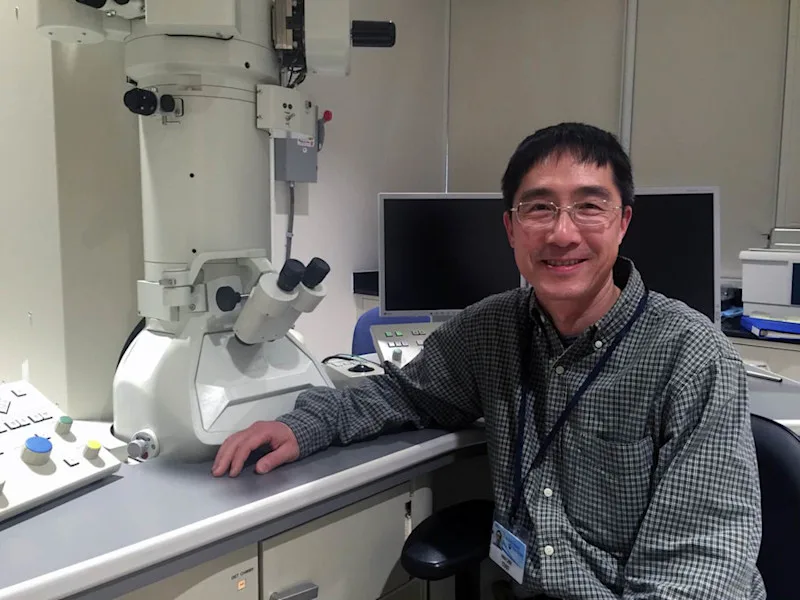
JEOL 1400 TEM
The JEOL 1400 TEM (Room C1727) is capable of generating ultra-structural nanoscale images from fixed cell/tissue samples or multiplexed immune-labeled samples.
Computer-controlled operations
Resolution up to 3 Angstroms
Magnification up to 370,000X
Capable of collecting data suitable for 3D reconstructions of negative-stained samples
Procedures, Protocols and Forms
Prospective users of the TEM Core can inquire about future projects, either by email, phone or in person. Prospective clients can explore the TEM Core’s fee schedule and set up a time to discuss the project in person with the TEM Core before providing specimens. Investigators should come to the meeting prepared with pertinent information relating to the specific project. At that time a request for specimen submission, including an estimate of costs for the project can be completed so clients and the TEM Core personnel are thoroughly familiar with the proposed project.
The TEM core’s primary goal is to generate high-quality data using electron microscopy. Specimen quality is essential to this process, as without properly fixed and prepared specimens, it is impossible to generate high quality interpretable images. It is our standard policy to review all protocols for incoming specimens and the we reserve the right to reject specimens and/or suggest necessary changes to aid in obtaining adequate and quality results.
Food and beverages are not permitted in the TEM core.
Users of the TEM and all major equipment must demonstrate competency to the TEM Core staff on the instrument before they may use it unassisted, even those who have qualified on similar instruments elsewhere before making the reservation. Users must be able to assess the working condition of an instrument. If an instrument is not working properly, the user should report this to the TEM core staff immediately.
Please register and make the reservation by using the iLab system.
Please follow the instructions at the TEM core.
Please refer to the protocols at the TEM Core.
Work With TEM core
Because of limited storage space, we may not store user samples indefinitely. All samples, including blocks and grids, may be returned to the user upon completion of a project.
We strongly recommend a positive and negative control for all experiments. The more information you provide, the easier it will be for us to evaluate and troubleshoot any problems that may arise in the processing of your samples.
Samples that are potentially dangerous to the users or staff of the TEM core may not be brought into the TEM core unless they are rendered harmless according to an approved protocol. The evidence of approval must be on file in the TEM core office. This policy includes but is not limited to bacterial, viral, carcinogenic, and radioactive samples.
The procedures for rendering them harmless must have been approved by the Institutional Biosafety Committee, Research Involving Infectious Agents Committee, and/or the Radiological Safety Board. The evidence of approval must be on file in the TEM core office.
Fixing the samples before bringing them into the TEM core is not sufficient; the full procedure and precautions for preparing the sample for TEM must be approved in writing after complete discussions with the TEM core staff.
Please contact the TEM core.
Services within the TEM cores are managed by the iLab core facility management program. New users must register in iLab to access instruments and services. Follow the quick links below for iLab registration and instructions. Please contact the TEM core to inquire about our services.
Please register and make the reservation by using the iLab system.
Citation
All publications, press releases or other documents that result from the utilization TEM core instruments, services or support are required to credit the core facility as follows:
“The TEM Core (RRID:SCR_021200) services and instruments used in this project were funded, in part, by the Pennsylvania State University College of Medicine via the Office of the Vice Dean of Research and Graduate Students and the Pennsylvania Department of Health using Tobacco Settlement Funds (CURE). The content is solely the responsibility of the authors and does not necessarily represent the official views of the University or College of Medicine. The Pennsylvania Department of Health specifically disclaims responsibility for any analyses, interpretations or conclusions.”
After the paper is published, please send reference details to hchen3@pennstatehealth.psu.edu.
Contact the Core

Han Chen, MD, PhD
Research Project Manager, Penn State College of Medicine