
MD Program
Accelerated Pathways
Three-Year MD Accelerated Pathways

A Unique Program
Penn State's accelerated MD Program is unique in that its pathways are designed to optimize the UME-GME continuum and allow students who already know their career path to progress into emergency medicine, family medicine, internal medicine, pediatrics, or psychiatry.
The benefits of the accelerated options include reduction of medical education costs and earlier career entry. The linkage of undergraduate and graduate medical education optimizes opportunities for continuity of patient care, mentoring and advising.
A Positive Impact
Penn State College of Medicine is a member of the national Consortium of Accelerated Medical Pathway Programs, initially funded by the Josiah Macy Jr. Foundation, which has conducted numerous studies that validated the positive impact of the 3-year accelerated programs.
A study that reviewed responses on the AAMC Graduation Questionnaire found that accelerated MD program graduates compared to four-year MD graduates:
Feel as satisfied with their medical education
Feel as prepared for residency
Have equivalent rates of burnout, with better ratings in some areas
Have lower student debt
Another study noted no significant differences in performance as measured by the ACGME milestones during the first year of residency between graduates of 4-year medical schools and 3-year accelerated programs.
Explore MD Three-Year Pathways

Emergency Medicine
Emergency Medicine is focused on the rapid evaluation, stabilization, diagnosis, and treatment of patients with undifferentiated illness and injury across all ages. It is uniquely suited for students who enjoy variety, high-acuity medicine, procedures, teamwork, critical decision-making, and caring for patients during some of the most important moments of their lives.
Family Medicine
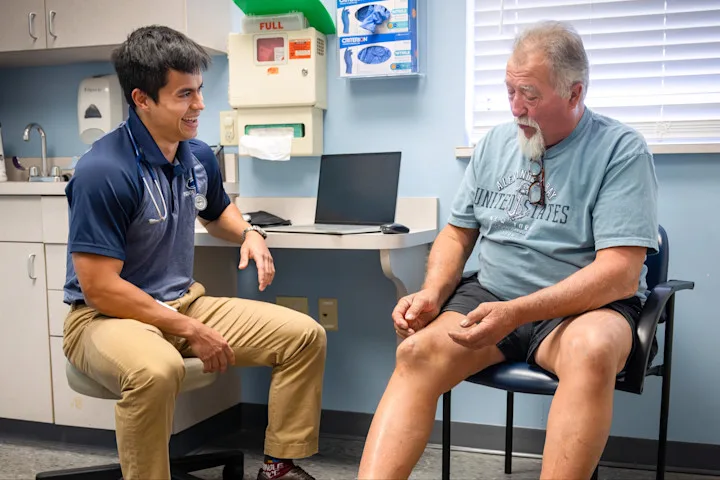
Family Medicine is focused on comprehensive, continuous, and relationship-centered care for individuals and families across all ages, genders, and stages of life. Family physicians are uniquely trained to diagnose and manage a broad range of acute and chronic conditions while emphasizing prevention, wellness, and coordination of care within the context of the patient’s family and community.

Internal Medicine
Internal Medicine is focused on the prevention, diagnosis, and treatment of diseases in adults. Internists care for patients with a wide range of conditions and often manage complex or chronic illnesses. Career pathways are diverse and include primary care, hospital medicine, academic medicine, research, and various subspecialties.

Pediatrics
Pediatrics offers the opportunity to shape health from the very beginning of life. The specialty combines the unique physiology and developmental needs of infants, children, and adolescents with high-acuity medicine, complex disease, advocacy, and lasting partnerships with families. For students drawn early to caring for children, pediatrics offers a deeply rewarding and intellectually diverse career.
Psychiatry
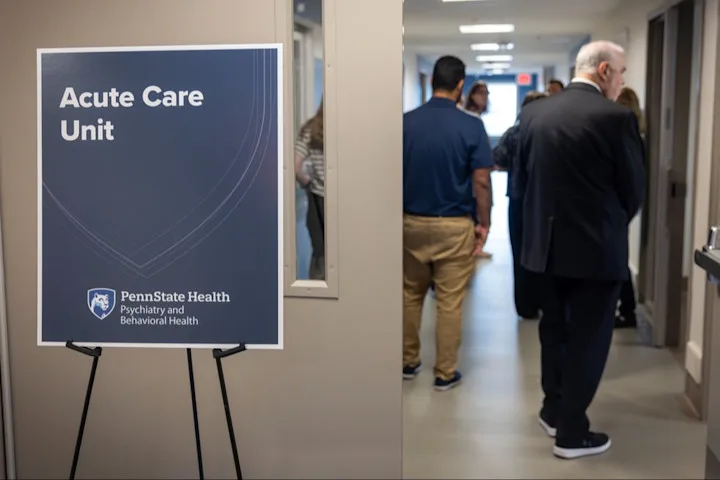
Psychiatry is a unique and evolving medical specialty that explores the intersection of the mind, brain and behavior. Psychiatrists play a vital role in preventing, diagnosing, and managing mental health conditions across all stages of life. Our Accelerated Pathway is designed for students with an early passion for the field, offering meaningful clinical experiences, personalized mentorship, and early exposure to the many career pathways that psychiatry has to offer.
Life of a 3+ Student





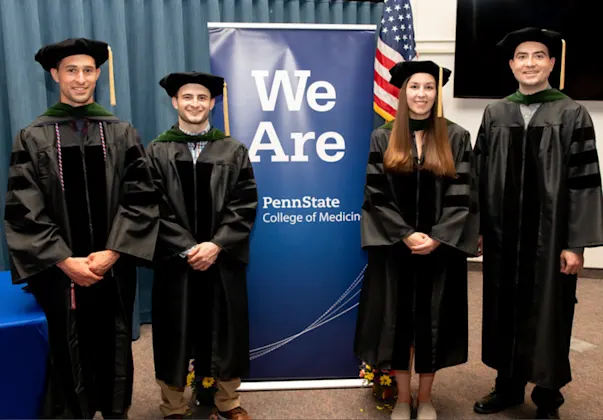
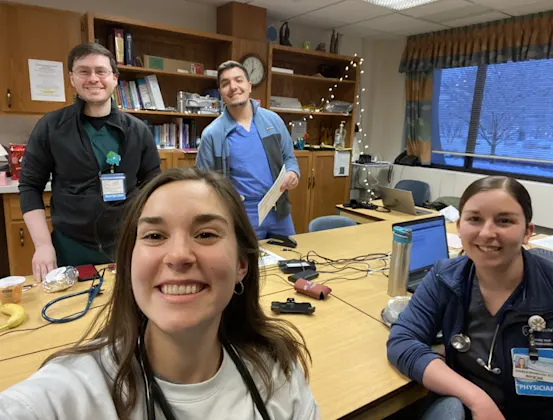


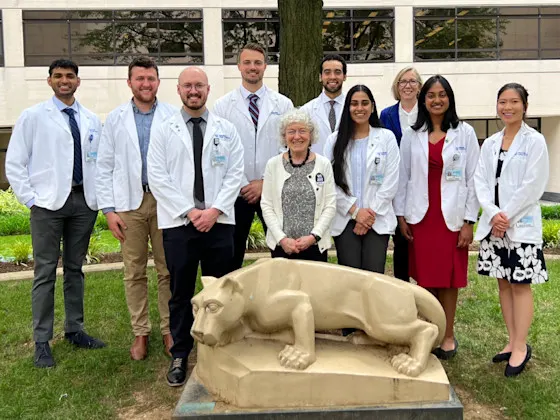
3+ students during a signing ceremony, marking the beginning of their journey.
Learning at the College of Medicine: The Problem Based Learning Way.
Focused time with faculty mentors.
Student collaboration in the College of Medicine courtyard.
Learning in the clinical setting.
Coaching from Faculty.
Celebrating Residency Match.
Commencement: The end of undergraduate medical education and the start of residency.
Residents on call.
Medical education leads to residency.
Social gathering to celebrate milestones with peers and faculty.
Scientist and Educator Pathways
Clinician Educator Pathway
Students complete all requirements for both the MD degree and the Master of Education (MEd) degree in four years.
Clinician Scientist Pathway
Students incorporate an extended period of research within the four years of medical school.
References
Satyamoorthi N, Marin M, Ludlow P, Triola MM, Gillespie C, Cohen E, Abramson S, Cangiarella J. Outcomes of Accelerated 3-Year MD Graduates at NYU Grossman School of Medicine During Medical School and Early Residency. Acad Med. 2025 Feb 1;100(2):184- 190. doi: 10.1097/ACM.0000000000005896. Epub 2024 Oct 15. PMID: 39402713
Cangiarella J, Gonzalez-Flores A, Fancher TL, Santen SA, Coe CL. Accelerated 3-Year MD Programs in the United States: Key Features, Innovations, Growth, Outcomes, and Lessons Learned. Acad Med. 2025 Jan 31. doi: 10.1097/ACM.0000000000005981.
Macerollo, A., Santen, S.A., Brenner, J, Cangiarella J, Gonzalez-Flores A, Jones BG, Leong SL, Roberts C, Traba CM, Strano-Paul L. When Accelerated MD Program Is Not the Right Path: The Why and How to Support Accelerated Learners in the Transition to the 4- Year Program. Med.Sci.Educ. (2025). doi: 10.1007/s40670-025-02328-5
Jones, B. G., Cook, R. C., Morales, F., Hobart, K., & Berk, S. L. The family medicine accelerated track at Texas Tech University Health Sciences Center: results from a 10-year program to bend the primary care curve. Medical Education Online, 2025 30(1). doi: 10.1080/10872981.2025.2457783
Chen F, Jordan KA, Li W, Lam Y, Pascarella L, Coe CL. Academic performance of students in an accelerated medical pathway. Med Educ Online. 2024 Dec 31;29(1):2345444. doi: 10.1080/10872981.2024.2345444. Epub 2024 Apr 28. PMID: 38678447
Santen SA, Yingling S, Hogan SO, Vitto CM, Traba CM, Strano-Paul L, Robinson AN, Reboli AC, Leong SL, Jones BG, GonzalezFlores A, Grinnell ME, Dodson LG, Coe CL, Cangiarella J, Bruce EL, Richardson J, Hunsaker ML, Holmboe ES, Park YS. Are They Prepared? Comparing Intern Milestone Performance of Accelerated 3-Year and 4-Year Medical Graduates. Acad Med. 2024 Nov 1;99(11):1267-1277. doi: 10.1097/ACM.0000000000005855. Epub 2024 Aug 23. PMID: 39178363.
Cangiarella J, Rosenfeld M, Poles M, Webster T, Schaye V, Ruggles K, Dinsell V, Triola MM, Gillespie C, Grossman RI, Abramson SB. Implementing an accelerated three-year MD curriculum at NYU Grossman School of Medicine. Med Teach. 2024 Dec;46(12):1575-1583. doi: 10.1080/0142159X.2024.2412796. Epub 2024 Oct 31. PMID: 39480996
Coe CL, Santen SA, Reboli AC, Boscamp JR, Stoltz AM, Latif E, Dodson LG, Hunsaker M, Paavuluri A, Brenner J, Ramanathan S, Macerollo A, Leong SL, Strano-Paul L, Traba C, Jones BG, Rundell K, Gonzalez-Flores A, Crump WJ, Vining M, Buchanan AO, Borschel DTM, Vitto CM, Cangiarella J. Accelerated 3YMD programs: the last decade of growth of the Consortium of Accelerated Medical Pathway Programs (CAMPP). Med Educ Online. 2024 Dec 31;29(1):2400394. doi: 10.1080/10872981.2024.2400394. Epub 2024 Sep 27. PMID: 39328035; PMCID: PMC11441013.
Cangiarella J, Cohen E. The importance of advising in an accelerated pathway program. Med Educ Online. 2024 Dec 31;29(1):2430053. doi: 10.1080/10872981.2024.2430053. Epub 2024 Nov 28. PMID: 39606866 Free PMC article.
Francesco Satriale, Arianna Winchester, Michael Partin. Voices of the accelerated: key themes when considering implementation of an accelerated medical school program. Medical Education Online, 29:1, 2385666, DOI: 10.1080/10872981.2024.2385666 doi: 10.1080/10872981.2024.2385666. 04 Aug 2024.
Miriam Hoffman, Lindsey Dedow & Jeffrey Boscamp. Competency based and less time-bound: a new approach to the macro-structure of a medical school curriculum, (2024) Medical Education Online, 29:1, 2343205, DOI: 10.1080/10872981.2024.2343205
Santen, S.A., Gonzalez-Flores, A., Coe, C.L. et al. Med.Sci.Educ. Return on Investment of Three-Year Accelerated Programs for Students, Medical Schools, Departments, and Community. (2024). doi: 10.1007/s40670-024-02043-7
Leong SL, Gillespie C, Jones B, Fancher T, Coe CL, Dodson L, Hunsaker M, Thompson BM, Dempsey A, Pallay R, Crump W, Cangiarella J. Accelerated 3-Year MD Pathway Programs: Graduates' Perspectives on Education Quality, the Learning Environment, Residency Readiness, Debt, Burnout, and Career Plans. Academic Medicine 97(2):p 254-261, February 2022
Abramson SB, Jacob D, Rosenfeld M, et al. A 3-Year M.D. -- Accelerating Careers, Diminishing Debt. N Engl J Med. 2013; 369:1085-1087.
Bower DJ, Jones BG, Pallay R, Prabhu FR, Buckley RD, Patterson LA. Three-Year Medical Degree Programs: Design Features of Accelerated Curriculum Tracks From Structurally Diverse Medical Schools. Fam Med. 2013:45(S3)
Emanuel EJ, Fuchs VR. Shortening Medical Training by 30%. JAMA. 2012;307(11):1143-1144
Grady D. The Drawn-Out Medical Degree. New York Times. August 1, 2014
Goldfarb S, Morrison G. The 3-year Medical School -- Change or Shortchange? N Engl J Med. 2013;369:1087-1089
Jones BG, Berk SL. The Family Medicine Accelerated Track Model: Producing More Family Doctors Faster. Virtual Mentor.14(11):845-853
Raymond JR, Kerschner JE, Hueston WJ, Maurana CA. The Merits and Challenges of Three-Year Medical School Curricula: Time for an Evidence-Based Discussion. Academic Medicine, October 2015; Volume 90 (10):1-6