Cancer Institute
Office for Cancer Health Equity
Reducing the Burden of Cancer in Central Pennsylvania
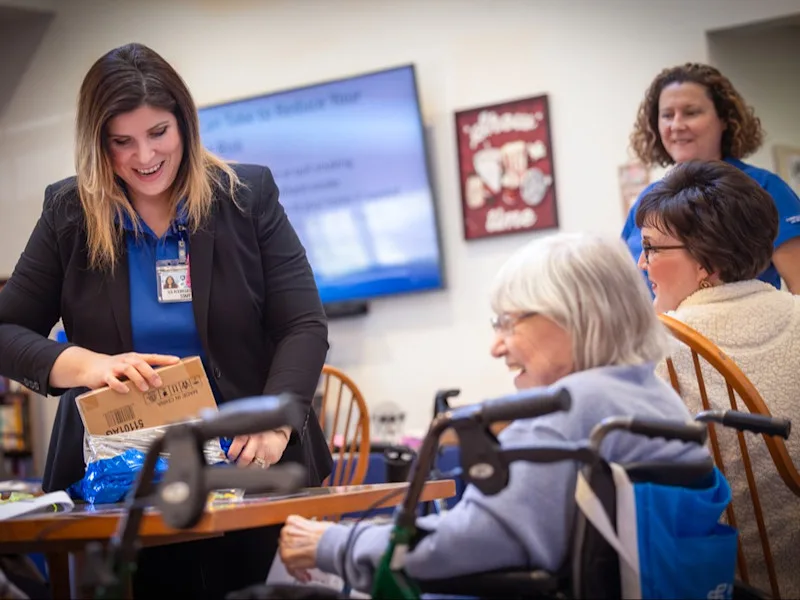
How We Make a Difference
Being a part of Penn State, we bring a wealth of leading-edge research and resources. Our mission is to reduce the burden of cancer through services that make a difference, especially for those who are at highest risk. We are equally as focused on preventing cancer, finding cancer early, treating it with the latest therapies, and helping cancer survivors enjoy life to its fullest. We are engaged with patient navigators, community health workers and promotoras because they serve a critical role in outreach, research and care.
We don’t do this alone. Residents, community organizations, and policy-makers have a vital role in achieving the vision that no one will die from cancer in central Pa. Everyone has an essential part to play. This is an ambitious vision, but together we can achieve it.
Cancer Institute Catchment Area Demographics
About the Office for Cancer Health Equity
The mission of the Office for Cancer Health Equity (OCHE) is to foster bilateral engagement between communities and partners in central Pennsylvania and Penn State that advances cancer health equity and reduces cancer burden for all. This engagement provides a foundation for world-class cancer research, care, outreach, education and policy development.
The vision of OCHE is to make certain no one in central Pennsylvania develops a preventable cancer or dies prematurely from cancer.
OCHE Focus
OCHE work is composed of:
Mapping and disseminating data on cancer and its determinants in central Pennsylvania and beyond. To see more data on cancer visit LionVu.
Promoting patient navigation to reduce the burden of cancer
Advising Penn State Cancer Institute on culturally appropriate clinical care
Helping to assure that minority and underserved populations have access to cancer education and research.
OCHE Central Pennsylvania Focus Area:
The Penn State Cancer Institute’s 28-county area comprises 4 million people.
OCHE is dedicated to relieving cancer burden for all populations, especially those in racial and ethnic minorities and rural populations.
Learn More About OCHE Projects
Hispanic/Latino Community Cancer Advisory Board (CAB)
Established in 2018, the Hispanic/Latino Community Cancer Advisory Board (CAB) serves as a bridge between the Penn State Cancer Institute (PSCI) and the Hispanic/Latino community in central Pennsylvania. The CAB advises the PSCI on all cancer issues that affect Hispanics/Latinos, reviews cancer-related research protocols, helps recruit study participants, and conducts outreach for cancer prevention and control.
The CAB has been instrumental in research related to collection of social determinants of health data from cancer patients, skin cancer risk perception and behavior among Hispanic/Latinos, colorectal cancer education and cancer screening among Latino men, overscreening for cancer among older adults, breast cancer prevention and screening among Latina women, and a Spanish-language cancer webinar series which has had domestic and international reach.
The CAB is composed of community leaders and organizations from central Pennsylvania. It is co-chaired by a community member and academic member and meets on a quarterly basis. The CAB always welcomes new community leaders with an interest in cancer prevention and control and will advocate for the Hispanic/Latino community in central Pennsylvania. If you would like more information, please contact OCHE@psu.edu.
Read more: Cancer Institute staff member advances health equity in central Pennsylvania.
Cancer Navigation and Survivorship Network (CaNSuN)
The Cancer Navigation and Survivorship Network (CaNSuN) is a hub for cancer patient navigation in Pennsylvania. Our mission is to connect, educate, develop and share best practices among patient navigators in Pennsylvania so that together we can successfully reduce barriers and increase access to cancer prevention, screening, treatment and survivorship services. In brief, we want to “help navigators navigate.” CaNSuN:
Disseminates navigation-related materials and tools
Shares best practice strategies for identifying and removing barriers to cancer screening and care
Fosters networking and communication among navigators
Promotes professional development opportunities
Identifies and collaborates on research to improve patient outcomes
Advocates for f navigation within healthcare systems, the community and the Commonwealth.
To accomplish this, we host monthly virtual meetings with state and national leaders and host an annual in-person summit. We also publish a monthly newsletter In 2021, we conducted a statewide environmental scan to better understand the landscape of navigation services in Pennsylvania and strategies best support navigators through network activities.
CaNSuN is advised by a steering committee of navigators, social workers, and community health workers, with representation from the PA Department of Health, American Cancer Society, and leading health systems and cancer centers.
Get Checked PA!: A training program for Community Health Workers (CHWs)
Established in 2022, Get Checked PA! is an evidence-based, multi-component initiative designed to reduce the cancer burden in Pennsylvania through the work of Community Health Workers (CHWs). Get Checked PA! is a train-the-trainer program to support instructors in CHW training programs and CHWs working in the field. A primary component is an interactive curriculum that equips CHWs with the knowledge and competency to improve cancer screening and early detection strategies in their community. Get Checked PA! provides participants with continuing education credits from the PA CHW Certification Board. One participant reported, “I enjoyed the overall content. The detailed information about certain types of cancer was very well explained and illustrated."
Get Checked PA! is developing a mentored, apprenticeship program with health care and community-based organizations who employ one of our graduates for cancer prevention and control.
LionVu
The OCHE has developed LionVu - a free online mapping resource and data portal. LionVu can be used by community members, program managers and researchers to understand the impact of cancer and cancer risk on communities throughout Pennsylvania. LionVu has more than 400 data variables, including social determinants of health, health care access and cancer outcomes.
Precision Cancer Screening Navigation
In 2021, the OCHE initiated ‘precision patient navigation’ as a strategy to support cancer survivorship. Our goal is detection and treatment of cancer at an early stage when treatment is most effective. ‘Precision patient navigation’ extends traditional screening navigation by using quantitative methods to assess a patient’s social determinants of health and clinical history so as to tailor one-on-one screening navigation. Our navigators, who hold master’s degrees in social work, utilize evidence-based strategies such as motivational interviewing and shared decision-making. This tailored approach increases the efficiency and effectiveness of traditional screening navigation. Working closely with Penn State Health, 200 women were offered ‘precision patient navigation’ for breast cancer during 2022-23.
The OCHE provides training in community-engaged cancer prevention, control and research to Penn State Cancer Institute (PSCI) members and affiliate members, Penn State students, and to persons enrolled in training programs within the Cancer Research Training and Education Core. Through educational experiences, trainees can become fully engaged in and learn the fundamentals of evidence- and theory-based cancer prevention and control in the real world. These training opportunities may involve working with OCHE faculty and staff on a community advisory board, community assessment, community education program, patient navigation, policy development or research study. The experiences can range from simple observation, co-leading an education program or advocacy initiative, navigating patients, conducting literature reviews, analyzing data or recruiting participants to a research study. The opportunity is most meaningful to the trainee and OCHE if it can occur over an extended period time (e.g., a semester), as opposed to taking place at a single occurrence or point in time. For most opportunities, the trainee and OCHE staff will collaboratively develop a written description of the objectives and milestones for opportunity. The description will also identify an OCHE mentor for the training.
For more information, contact OCHE@psu.edu.
Through the OCHE training opportunities, trainees may have the opportunity to work with the following groups or programs.
Cancer Navigation and Survivorship Network
Working with this program, past trainees have analyzed newsletter engagement and conducted an environmental scan on the state of patient navigation in Pennsylvania. Future opportunities for trainees may include researching newsletter content, researching and developing protocols for online community forums, data analysis and observation of monthly meetings.
Cancer Prevention in Pennsylvania Initiative
The Cancer Prevention in Pennsylvania Initiative is a partnership between Penn State Extension and Penn State Cancer Institute, to bring evidence-based cancer prevention initiatives to residents of Pennsylvania, especially those who live in rural communities. Training opportunities with this initiative include researching, developing and delivering presentations and materials on rural cancer disparities.
Community-engaged Research
OCHE leads and assists investigators with community-engaged research to reduce cancer health disparities in central Pennsylvania. These studies primarily focus on Appalachian, Hispanic/Latino and African American populations. Training opportunities related to community-engaged research include analyzing research and surveillance data, recruiting participants to studies and assisting with regulatory approval. Training in human subject protection is expected.
Get Checked PA
Get Checked PA is an evidence-based, train-the-trainer program designed to equip certified community health workers in the knowledge and skills to educate their communities in best practices for cancer prevention and screening. Training opportunities include observation, co-leading a session, developing new curriculum or evaluation.
Hispanic/Latino Cancer Community Advisory Board
The Hispanic/Latino Cancer Community Advisory Board (H/L CAB) is composed of individuals and representatives of community organizations, including social and broadcast media. The H/L CAB meets on a quarterly basis to review study proposals, assist with study recruitment, and catalyze community education. Examples of training opportunities with OCHE include observation of the H/L CAB, co-developing education programs, disseminating of information, and analyzing research and surveillance data. Fluency in Spanish is preferred, but not required.
Precision Cancer Screening Navigation
Precision Cancer Screening Navigation is an evidence-based telephonic cancer screening navigation program for persons who are overdue for recommended cancer screenings. The Navigation incorporates interviewing skills, including Shared-Decision Making, Motivational Interviewing, and Shulman Interactional Helping skills. Examples of training opportunities with OCHE could include observation, developing new screening protocols, analyzing existing data or, for those who have necessary patient and health system clearances, supervised patient navigation.
Cancer Prevention in Pennsylvania Initiative
Begun in 2020, the Cancer Prevention in Pennsylvania Initiative (CPPI) is a collaboration between Penn State Extension (Extension) and the Penn State Cancer Institute (PSCI). The long-term goal is to reduce the burden of cancer in Pennsylvania through knowledge, behavior change and access to recommended health care services. The CPPI focus is broad, ranging from cancer risks (i.e., nutrition, physical activity) to quality of life (e.g., mental health) for cancer survivors. Extension has substantial reach with a presence in each of the 67 counties in Pennsylvania; their robust education and training program is a trusted source of information for Pennsylvania residents. PSCI has strong research and clinical services in cancer prevention and control. This collaboration offers a unique opportunity to raise awareness and change behavior among Pennsylvania residents to reduce cancer risk and improve outcomes.
Projects
Walk by Faith
Walk by Faith is an evidence-based prevention program to improve the health of overweight and obese individuals in Appalachia. After piloting the program, PCSI then partnered with Extension to adapt and disseminate the program to more rural Pennsylvanians. Extension educators have redeveloped the program as a train-the-trainer curriculum to be offered by Extension statewide.
Learning Products
The team developed learning products focused on cancer prevention tailored to the Extension audience. These Factsheets, Learn Now videos and articles are posted on the Extension site and below.
Cancer Prevention – Limiting Processed and Red Meats in the Diet (FactSheet)
How to Enjoy the Sun Safely (Learn Now Video)
Lunch and Learns
Lunch and Learns are an internal program focused on building and strengthening the relationships between PSCI and Extension staff. They provide opportunities to share expertise with team members not directly working on the CPPI team, and to continue to explore areas for future collaborative efforts.
Partnership examples:
Dr. Susan Veldheer is working with Extension on the Growing Healthy Hearts intervention. This is an integrated gardening, cooking and nutrition education program being delivered via Zoom and Facebook. An Extension educator and dietitian is working with Susan’s team to help with content creation. Once developed and tested, Extension may also deliver the program.
Penn State Health Dermatology has provided sun safety and skin cancer education at Ag Progress Days and the PA Farm Show. In 2023, skin cancer screenings will also be offered.
Meet the Team

William Calo, PhD, JD, MPH
Interim Associate Director, Community Outreach and Engagement, Penn State Cancer Institute

Sol Rodríguez-Colón, MS
Research Manager, Office for Cancer Health Equity, Penn State Cancer Institute

Holly Dolan, MAT, MCHES
Community Engagement Manager, Office for Cancer Health Equity, Penn State Cancer Institute

Kate Konkle, MPH
Educator Specialist, Penn State Cancer Institute

Karen Ostrander, MSW, LSW
Lead Cancer Screening Navigator, Office for Cancer Health Equity, Penn State Cancer Institute